%404x.png)
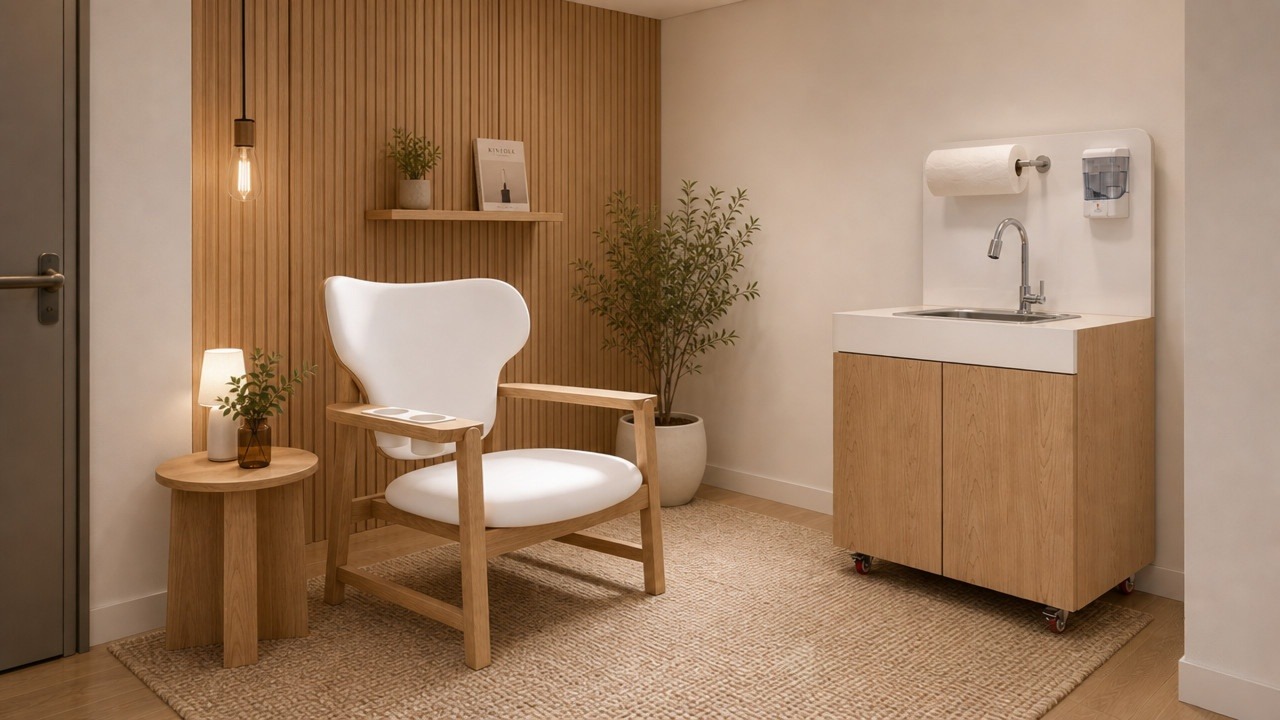
Someone in HR gets the email. A new parent is coming back in three weeks and needs a place to pump. The first instinct, more often than not, is to picture drywall, a contractor's quote, and a plumbing line that has to tie into the building somehow. None of that is actually true. Setting up a workplace lactation room without construction or plumbing is not just possible; it is how most compliant spaces get built today, and the difference in both timeline and cost is not subtle. Weeks instead of months. An outlet instead of a permit.
So where does the construction myth come from? Probably from the word "room" itself. People hear about the lactation room and picture a renovation. But the law was never written around square footage or plumbing fixtures. It was written around privacy and function.
What the law actually requires
Worth slowing down here, because a lot of outdated advice is still floating around.
Under the Fair Labor Standards Act, as expanded by the PUMP for Nursing Mothers Act, employers must give nursing employees reasonable break time and a private place to pump, available each time they need it, for up to one year after a child's birth. The Department of Labor's Fact Sheet #73A, which addresses space requirements specifically, says the location has to be functional for pumping, shielded from view, free from intrusion, available as needed, and not a bathroom. A flat surface for the pump. Somewhere to sit.
Nowhere does it say plumbing or permanent construction. The Department of Labor is actually explicit that employers are not required to build dedicated, permanent spaces; some choose to, but a repurposed office with the right setup satisfies the law just as well.
None of which requires a contractor. So what does it require?
Start with the room you already have
Most offices, even small ones, have some room that is underused. A spare office, a corner of a wellness suite, a conference room nobody books on Tuesdays.
If that room has four walls, a door that locks, and an outlet, you are most of the way there. What it usually lacks is the actual function: somewhere comfortable to sit and appropriate for pumping, a flat surface for pump equipment, a sink, and a way to keep milk cold nearby instead of walking it to a shared kitchen fridge.
This is where furniture, not construction, closes the gap. A lactation chair built specifically for pumping, with ergonomic support, wipeable medical-grade upholstery, and armrest bottle holders sized for major brands, turns an empty office into a real pumping room in the time it takes to carry it through the door. No electrician. No inspection.
The all-in-one option, for rooms with nothing in them yet
Sometimes the available room is genuinely bare. No chair, no desk, nothing. That is where a lot of employers assume they need to bring in plumbing, mostly because they are picturing a sink.
The Nessel all-in-one lactation station was built around that exact assumption and designed to prove it wrong. It ships fully assembled and fits rooms as small as 5 feet by 7 feet, which is smaller than most people expect. The chair, a patented sliding workstation for laptops or paperwork, power outlets, and an integrated, temperature-controlled refrigerator all arrive as one unit. If the room already has plumbing nearby, great. If it doesn't, the station's sink option is self-contained and plumbing-free, so that is never the blocker, it seems like on paper.
Plug it in. That's the install.
No room at all? That's what lactation pods solve.
Some offices genuinely have nothing to spare, not a closet, not a corner. That used to mean the lactation program stalled at the planning stage. It doesn't anymore.
A freestanding lactation pod is essentially a finished room you place inside the office rather than a room you go hunting for. They come in multiple sizes, from a compact 13 square foot Petite for tight lobbies and hallways, up through a 35 square foot Standard and a 60 square foot Extra. The Standard and Extra are both ADA compliant. Both the Standard and Extra are roomy enough to hold a full lactation station inside, sink and fridge included. They're among the few soundproof pod options available, with five inches of acoustic insulation and skylights, plus ventilation that cycles fresh air roughly once a minute so the space never feels stuffy.
Lactation pods are assembled on site rather than shipped fully built like the station, but assembly is still a matter of hours, not a construction project with a timeline measured in weeks. No permits. No plumbing crew.
Buy it, or try renting first.
Not every company wants to commit to a purchase before knowing how many employees will actually use the space. That's fair, and it's also solvable without construction thinking creeping back in.
Both stations and some pods are available to rent, not just buy, though the terms differ. The lactation station rents with a six-month minimum. Pods are more flexible, available on daily and monthly rentals with no long-term commitment required. For a small office covering a single returning parent, or testing the waters before a larger rollout, that range of options tends to be the whole appeal. You are not locked into a fixed asset while you figure out demand.
A quick reality check on timing
It's worth naming the actual contrast plainly, because it's often what convinces a budget-conscious employer to move.
- Construction route: design, permitting, contractor scheduling, plumbing tie-in, inspection. Realistically, two to four months, sometimes longer depending on your building and location.
- Furniture route: order, ship, plug in. Often just a few short weeks or sooner, depending on lead time.
Given that new parents are usually back at their desks within weeks of the space being requested, that gap matters more than it might seem at first glance.
The takeaway
A workplace lactation room does not need a construction budget to meet the law or, more importantly, to actually work for the person using it. It needs privacy, a locking door, and equipment that does the job a plumbed-in room would have done anyway, just without the mess of getting there.
At Nessel, we build for exactly that gap, furniture designed by moms, for moms, so that "we don't have the space" stops being the end of the conversation. If you're staring down a return-to-work date and wondering how fast a compliant room can actually come together, get in touch with Nessel, and we'll walk you through the options that fit your floor plan.
Frequently Asked Questions
Does a workplace lactation room legally need a sink? No. The PUMP ACT requires a functional, private, non-bathroom space, not plumbing. A nearby sink is highly recommended but not legally required. Options like a self-contained, plumbing-free sink can cover that need without construction.
How small can a compliant lactation room be? There's no minimum square footage written into federal law, only that the space be functional and private. In practice, a room as small as 5 feet by 7 feet can work with the right furniture, and compact pods start around 13 square feet.
Do companies with fewer than 50 employees have to provide a lactation space? Generally yes. The undue hardship exemption for smaller employers is narrow and evaluated case by case, not assumed. Small employers still have to comply unless they are granted this exemption.
How long does it take to set up a lactation room without construction? Furniture-based setups, whether a chair added to an existing room or a full station or pod, can be quick. These solutions can typically take days to a couple of weeks from order to install, compared to two to four months for a construction-based buildout.
Sources: U.S. Department of Labor, Fact Sheet #73A: Space Requirements for Employees to Pump Breast Milk at Work under the FLSA (dol.gov); U.S. Department of Labor, FLSA Protections to Pump at Work (dol.gov); Center for WorkLife Law, Lactation Accommodations guidance (worklifelaw.org / pregnantatwork.org).
Legal Disclaimer: This article is provided by Nessel for general informational purposes only and does not constitute legal advice. Employment laws change frequently, and their application varies based on individual circumstances. Before making compliance decisions, consult a licensed attorney or qualified HR professional regarding your specific situation.
%404x.png)
