%404x.png)
When a new parent prepares to return to work after having a baby, the logistics of continuing to breastfeed or pump can feel overwhelming. Will there be a private space? Will it be clean? Will they feel supported, or like an afterthought?
For HR professionals and employers, this moment is both a legal responsibility and a genuine opportunity. The difference between a workplace that merely checks a compliance box and one that truly supports its people often comes down to a single room and what's inside it.
This blog breaks down exactly what the law requires, what a legally compliant lactation space actually looks like, and how the right setup turns a mandatory accommodation into a meaningful statement of employee care.
What the Law Actually Requires
The PUMP for Nursing Mothers Act (PUMP Act), which became law as part of the Consolidated Appropriations Act of 2023 and went into full enforcement effect on April 28, 2023, significantly expanded federal protections for breastfeeding employees. Enforced under the Fair Labor Standards Act (FLSA) by the U.S. Department of Labor's Wage and Hour Division, the PUMP Act now covers nearly all employees, including salaried workers, teachers, nurses, farmworkers, and many others who were previously excluded under the 2010 Break Time for Nursing Mothers provision.
The law has two core requirements for employers:
- Reasonable break time to express breast milk each time the employee needs to, for up to one year after a child's birth.
- A private space, that is not a bathroom, shielded from view and free from intrusion by coworkers or the public.
Employers of all sizes are covered. Those with fewer than 50 employees may claim an undue hardship exemption, but the Department of Labor notes this is extremely rare. Additionally, many states have enacted protections that go further than federal law. New York, California, Connecticut, and others impose additional requirements around room amenities, proximity to the work area, and duration of protection (New York, for example, extends protections up to three years following childbirth).
Employers who fail to comply risk formal complaints with the Department of Labor, as well as private lawsuits. Employees are required to give employers 10 days' notice before filing a lawsuit for space violations, giving organizations a narrow window to course-correct. Non-compliance can result in remedies including reinstatement, lost wages, emotional distress damages, and attorney's fees.
The takeaway for employers is clear: this is not optional, and the cost of non-compliance far exceeds the cost of creating a proper space.
The Critical Distinction: What "Privacy" Actually Means Under the Law
Here is where many employers get tripped up, and where compliance can unintentionally fall short.
A lactation station, on its own, does not satisfy the PUMP Act's privacy requirement. This is an important legal and practical distinction. A lactation station, however well-designed, is furniture. It provides a functional workstation for pumping parents, but furniture alone cannot create privacy. Privacy, under the law, means the space itself is shielded from view and free from intrusion. That requires four walls and a door.
The legal requirement is met by a lactation room or pod in which the station sits, not by the station itself. Think of it this way: a lactation station is what goes inside a compliant space; it is not the space itself.
Moving Beyond Compliance: What a Supportive Space Actually Feels Like
Legal compliance is the floor, not the ceiling. The employers who see the strongest return on their lactation support investment are those who go beyond minimum requirements to create a space where employees genuinely feel supported.
Consider what a pumping parent actually experiences: they may pump two to three times per 8-hour workday, for roughly 30 minutes each session, nearly 1.5 hours daily. That time is non-negotiable for parents committed to breastfeeding. How that time feels, rushed and stressful, or calm and dignified, has a direct impact on whether an employee can be productive, present, and retained.
Research consistently supports this: for every $1 invested in corporate lactation programs, companies see approximately $3 in returns through improved employee retention, reduced absenteeism, and lower healthcare costs. That is not a marginal return, it is a compelling business case.
How Nessel Helps You Build a Space That Does Both
Nessel is a certified Women-Owned Small Business whose mission is to improve lives and strengthen communities through innovative design. Every Nessel product is designed by people who have lived the experience of being a pumping parent at work, and it shows.
Here is how Nessel's product ecosystem helps employers build lactation spaces that are both legally compliant and genuinely supportive.
The Nessel Lactation Pod: Privacy, Anywhere
For workplaces that do not have a dedicated room, or that need to quickly create privacy in an open-plan environment, the Nessel Lactation Pod is the solution. The pod is what creates the legal privacy requirement: it functions as an enclosed, private space that satisfies the PUMP Act's mandate that the lactation accommodation be shielded from view and free from intrusion.
A few features that set the Nessel pod apart:
- Soundproofing: The Nessel Lactation Pod is soundproof, featuring five inches of sustainable acoustic insulation for complete privacy.
- Natural light: Skylights flood the interior with natural light, making the space feel open, airy, and welcoming, not clinical or closet-like.
- Ventilation: High-powered ventilation brings fresh air into the pod once every minute, ensuring the space is always comfortable and breathable.
- Sustainable materials: All Nessel pods are crafted from sustainable and recycled materials, are Clean Air Gold Certified, and use natural mineral wool insulation, with no polyurethane foam or formaldehyde. They are proudly made using locally sourced and renewable materials.
Importantly, the Nessel pod requires on-site assembly and installation. It does not arrive pre-installed. Employers should plan for this process when coordinating rollout timelines, and Nessel's team is available to support you through setup.
The Nessel Lactation Station: A Complete Functional Workstation
Once your private room or pod is in place, the Nessel Lactation Station transforms it into a fully functional pumping environment. The station is plug-and-play, it arrives fully assembled and requires only a standard 110V/15-amp power outlet. No plumbing. No renovations. No contractors.
The patented Lactation Station includes:
- A portable, plumbing-free sink capable of up to 70 hand-washings before needing a refill, with BPA-free water tanks and an optional touchless infrared sensor faucet.
- Private refrigeration for milk storage, so employees never have to use a shared office fridge.
- Integrated power outlets for electric breast pumps.
- A sliding workstation so parents can stay productive during sessions.
The station is built from FSC, LEED, and Eco-certified non-toxic wood laminate with CARB2 compliance, formaldehyde-free and finished with water-based solvents only.
The Nessel Lactation Chair: Designed for the Experience
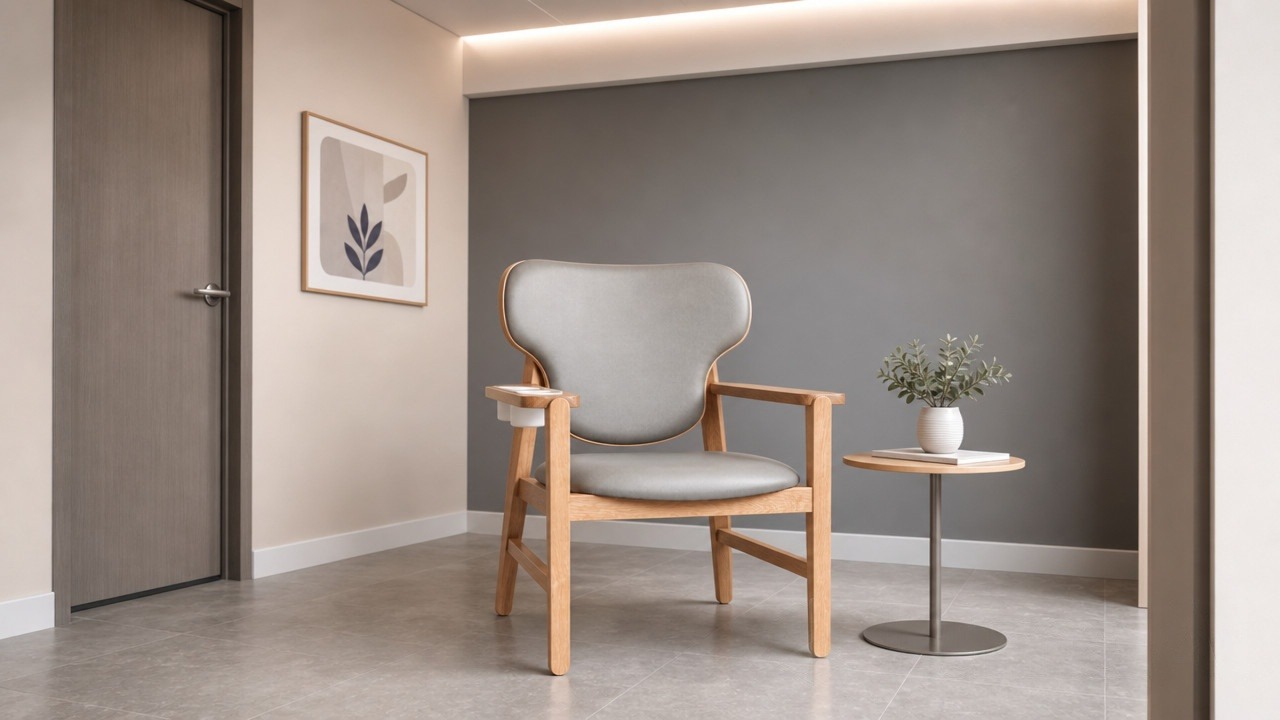
The Nessel Lactation Chair is the only pumping chair of its kind, designed specifically for breastfeeding parents at work. Key features include:
- Ergonomic design with wide armrests at exactly the right height for stabilizing pump flanges, reducing physical fatigue across multiple daily sessions.
- Medical-grade GREENGUARD-certified silicone upholstery that is wipeable, stain-resistant, and easy to sanitize between users, essential for shared spaces.
- Custom bottle holders snuggled into the armrests, compatible with all major bottle brands.
- Compact dimensions (27.5"W x 22.5"D x 36"H) designed to fit efficiently in smaller rooms without sacrificing comfort.
The ROI of Doing This Right
The business case for investing in a well-equipped lactation space is supported by data. Breastfeeding employees pump an average of three times per 8-hour workday. Without a safe, convenient, and dignified space, those sessions become a source of daily stress, affecting focus, morale, and ultimately, the likelihood that a talented employee returns after parental leave at all.
When companies invest in the right setup, they signal something powerful: we see you, we planned for you, and we want you here. That signal, backed by a clean, private, well-equipped room, is one of the most effective retention tools available to HR teams today.
Getting Started
Creating a compliant and supportive lactation space does not require construction, plumbing, or a large facilities budget. With Nessel's suite of products - the lactation pod, lactation station, lactation chair, and portable sink, employers of any size can be up and running quickly, legally, and thoughtfully.
Whether you are outfitting a new office, preparing for an employee's return from parental leave, or auditing your current setup against PUMP Act requirements, Nessel is here to help.
Visit www.nessel.com to explore products, request a quote, or speak with the Nessel team about your organization's specific needs.
%404x.png)
