
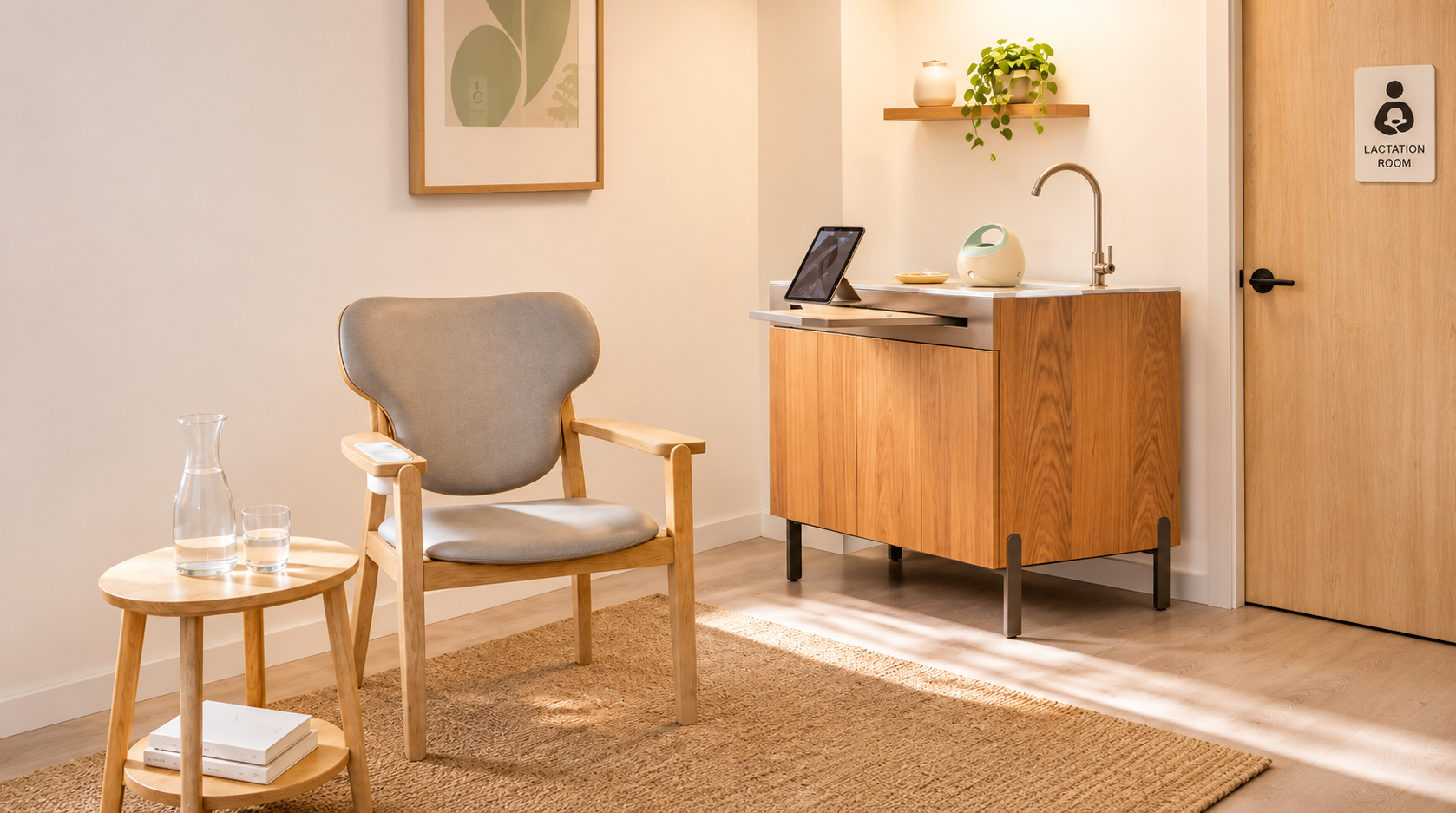
There's a moment every pumping parent knows well. You're twenty minutes into a session, perched on the edge of a folding chair or some leftover office seat nobody wanted, and your lower back has started to ache. Your arm is cramping from holding a pump at an odd angle. You're thinking about the meeting you're missing, not about your milk supply. This is exactly why a lactation chair matters so much more than people assume, and why the right seating can be the difference between a rushed, uncomfortable pumping break and one that actually works.
Pumping isn't a five-minute task. Depending on the person, a full session can run thirty minutes, sometimes longer if a letdown is slow to arrive or if a parent is exclusively pumping. Multiply that by two or three sessions a day, five days a week, for months at a time, and you start to see why the seat someone sits in matters just as much as the pump itself.
The Posture Problem Nobody Talks About
Most workplace "lactation rooms" started out as an afterthought. A converted supply closet. A repurposed conference room with a lock added to the door. And whatever chair happened to be sitting around usually ended up in there too, whether or not it was ever meant for someone to sit still in for half an hour at a time.
Here's the catch. A chair that reclines, or one that's too soft, or one without real back support, actually works against the pumping process itself. Leaning back changes the angle of the breast in a way that makes complete milk expression harder. Slouching forward to compensate strains the neck and shoulders. Neither position helps anyone complete a session efficiently, and neither one makes a parent want to come back tomorrow and do it again.
This is the specific problem a lactation chair is built to solve. It's designed to keep a pumping parent upright, which is the position that best supports proper flange alignment. When someone sits upright with real lumbar support underneath them, their body isn't fighting the chair for the entire session. That alone changes how long a person can comfortably sit and pump and how they feel when they stand back up.
Why Duration Depends on Design, Not Willpower
It's tempting to think that pushing through discomfort is just part of the deal, something new parents grit their teeth through because there's no other option. But that mindset misses something important: the length and quality of a pumping session are largely a design problem, not a willpower problem.
Think about what actually happens over a thirty-minute stretch. Someone's arms are often extended to keep pump flanges in place. Their back is stationary. Their shoulders may be hunched. Small discomforts that seem minor in the first five minutes become genuinely distracting by minute twenty, and distraction during pumping isn't a small thing. Stress and tension can interfere with letdown, which means an uncomfortable chair doesn't just make the session feel longer; it can actually make it take longer.
A few features make a real difference here:
- Back and lumbar support. Sitting upright without support for thirty minutes is its own kind of workout. A chair built with proper back support lets the muscles around the spine actually relax instead of working overtime just to hold a person steady.
- Wide, sturdy armrests. Arms need somewhere to rest without hunching forward or holding a pump mid-air. Wide armrests give parents a stable surface for the pump itself, along with room for a laptop, phone, or a book, so the session doesn't have to feel like dead time.
- A dedicated spot for bottles. Spilled milk during a long session is more than an inconvenience. It's lost time, lost effort, and, for a lot of parents, a genuinely upsetting moment after they've worked hard to produce that milk in the first place.
The Nessel lactation chair was built around these exact pain points, with a design that keeps the body upright, armrests wide enough to hold a pump and a laptop side by side, and built-in bottle holders sized to fit the major pump brands so nothing tips during a session. It's a small list of features, but each one addresses a specific reason why long pumping sessions become uncomfortable in the first place.
Comfort That Holds Up to Daily, Repeated Use
There's another piece to this that doesn't get talked about enough: hygiene. A chair that's used multiple times a day, by one person or by many rotating through the same lactation room, needs to be genuinely easy to clean. Fabric upholstery holds onto spills, odors, and bacteria in a way that just isn't practical for a space meant to support health and cleanliness.
That's part of why medical-grade, GREENGUARD-certified silicone upholstery matters so much for a chair built specifically for this purpose. It wipes clean in seconds; it's bleach-safe for real sanitization between uses, and it doesn't hold onto smells the way fabric does. For a parent walking into a lactation room after someone else just used it, knowing the seat is clean isn't a minor detail. It's part of feeling comfortable enough to actually settle in and finish a full session instead of rushing through it.
Turning Dead Time Into Something More Manageable
There's a practical side to longer sessions that's easy to overlook until you're living it. Thirty minutes, three times a day, adds up to an hour and a half that has to come from somewhere in an already packed workday. For a lot of parents, the only realistic way to make that math work is to bring some of their job into the pumping room with them, answering a few emails, reviewing notes before a call, or just catching their breath before heading back to their desk.
A chair with nowhere to set a laptop or a notepad makes that basically impossible. Balancing a computer on your knees while also holding pump flanges in place isn't multitasking; it's just two hard things happening badly at the same time. Wide armrests solve a real problem here, giving parents a stable place to work if they choose to, without turning the session into a juggling act. Some days that might mean returning a few messages. Other days it might just mean sitting quietly for a moment, which matters too. Either way, having the option changes how draining that hour and a half feels by the end of the week.
There's also a quieter benefit worth mentioning. When a chair is built specifically for this purpose, it removes a dozen tiny frictions that most people never consciously notice but absolutely feel. Not having to hold a bottle steady with one hand. Not having to prop a pump on your knee. Not wondering if the seat cushion is clean. Each of those frictions is small on its own, but stacked together across a thirty-minute session, they're the difference between a break that restores a parent and one that just adds to their fatigue.
The Legal Backdrop, and Why "Just a Chair" Isn't Really Just a Chair
So what does the law actually require here? Under the federal PUMP Act, officially the Providing Urgent Maternal Protections for Nursing Mothers Act, employers are required to give employees reasonable break time to express milk for up to one year after a child's birth, along with a private space that isn't a bathroom, is shielded from view, and is free from intrusion. The law, which built on and closed gaps in the earlier 2010 Break Time for Nursing Mothers Act, extended these protections to millions of workers who weren't previously covered, including many salaried employees, teachers, and nurses.
Here's what often gets missed, though. The law focuses on whether a space exists and functions as intended, not on how comfortable it is to actually use. A locked private room with a folding chair technically checks the box. But a room that's uncomfortable enough that employees avoid using it, or rush through sessions faster than they should, isn't really meeting the spirit of what the law was written to protect. According to the Center for WorkLife Law, which helped shape the model legislation behind the PUMP Act, the goal was always about protecting the health and dignity of nursing employees, not just the letter of a legal minimum.
This is where a well-designed lactation chair earns its place in the conversation about legal compliance. It's not mentioned anywhere in the statute, and it doesn't need to be. But a chair that actually supports a full, comfortable session is what turns a technically compliant room into a space employees are willing to use consistently, which is really the whole point of the law in the first place.
The Emotional Weight of Returning to Work
It's worth pausing on something that isn't about ergonomics or legal code at all. Returning to work after having a baby is hard, full stop. There's the guilt of leaving a newborn, the physical recovery still happening in the background, and then, on top of all that, the very specific stress of figuring out how and where to pump during a workday that wasn't built with that in mind.
Many parents describe feeling like pumping at work is something to apologize for, something to squeeze into the margins of the day as quickly and quietly as possible. A cramped, uncomfortable space reinforces that feeling. It sends a message, even if it's unintentional, that this need is a burden rather than something a workplace has genuinely planned for.
A comfortable, well-designed lactation space says the opposite. It tells a parent, without anyone having to say a word, that they were thought about, planned for, and welcomed back. That kind of quiet signal matters more than most employers realize, and it shows up later in things like retention and morale that are much harder to measure in the moment.
What This Actually Means for Employers
Investing in the right lactation chair isn't just about checking a compliance box. It's about recognizing that the length and quality of a pumping session directly affect how supported an employee feels, how quickly they can get back to their workday, and, honestly, how successful their pumping journey ends up being overall.
A few things worth considering when evaluating a space:
- Does the seating keep employees upright and supported, rather than reclined or slouched?
- Can the chair genuinely be sanitized between uses, especially in a shared space used by multiple employees?
- Is there a stable, wide surface for pump equipment, bottles, and work materials, so a session doesn't turn into a balancing act?
- Would an employee actually want to sit there for thirty minutes, or would they rush through it just to get out?
That last question might be the most honest measure of whether a lactation space is really working. A chair that's actually comfortable changes behavior, encourages full sessions, and quietly tells every parent who sits down in it that someone thought this through.
Nessel built our lactation chair around exactly that idea, designed specifically for pumping, not repurposed from somewhere else in the building. Because the goal was never just to fill a room with furniture. It was to give parents a seat that actually supports the work their bodies are doing, for as long as that work takes.
The takeaway is a simple one, even if it's easy to overlook. Pumping is not a quick errand. It deserves a chair that treats it with the dignity it so deserves.
Frequently Asked Questions
How long does a typical pumping session last?
It varies by person, but most sessions run somewhere between twenty and thirty minutes, and multiple sessions are usually needed across a workday. That's a meaningful stretch of time to sit in a chair that wasn't built for the job.
Is a lactation chair different from a nursing glider?
Yes. A nursing glider is meant for feeding an infant at home and relies on a rocking or gliding motion to soothe the baby. A pumping session, on the other hand, requires the parent and their equipment to stay still, so a lactation chair uses a stationary base with upright, supportive seating instead.
Does a workplace legally have to provide a chair, specifically?
The PUMP Act requires a private, functional, non-bathroom space with reasonable break time, but it doesn't spell out furniture requirements down to the chair. That said, a space that's technically compliant but genuinely uncomfortable tends to go unused, which defeats the purpose the law was written to serve.
What is the Nessel lactation chair made of, and how do you clean it?
Our chair is built on a solid maple frame and upholstered in medical-grade, GREENGUARD-certified silicone that's available in white or grey. It's bleach-safe for real sanitization and wipes down in seconds, which matters for a shared space used multiple times a day.
Will it fit in a small lactation room?
The chair measures 31 inches wide, 25 inches deep, and 37.5 inches high, and it's designed to fit sideways through small doorways, so it works in compact converted spaces as well as larger dedicated rooms.

