
Picture this. An employee tells HR she's returning from maternity leave in three weeks, and she'll need somewhere private to pump. The room down the hall is full of storage boxes. Facilities says construction estimates run well over twelve weeks and cost over $50k in labor, design, and materials. Suddenly, building a corporate lactation room feels like a project nobody has time for, and a legal requirement nobody can afford to skip.
Here's the thing though: it doesn't have to work that way.
The Clock Is Already Running
Under federal law, most employers don't get to treat this as optional. The PUMP Act, which amended the Fair Labor Standards Act, requires covered employers to provide a private space, not a bathroom, that's shielded from view and free from intrusion, for nursing employees to express milk. According to the Department of Labor's Fact Sheet #73, revised in December 2025, this applies to nearly all FLSA-covered employees, including those who telework.
So what does that mean in practice? A closet with a lock qualifies as a starting point. A phone booth room does too, so long as they are free from view (read: no unshielded windows). What doesn't qualify is a bathroom, even a nice one, and it doesn't matter how convenient it seems.
The frequency and duration of breaks will vary from employee to employee, but the space itself has to be ready whenever it's needed. That's where a lot of employers get stuck. They know the requirement. They just don't know how to meet it without a renovation budget and a contractor on speed dial.
Why Construction Was Never the Answer
Traditional build-outs involve permits, contractors, plumbers, electricians, and a timeline measured in months, not days. By the time the room is finished, the employee it was meant for may have already returned to work and figured out some makeshift solution on her own. That's not a great first impression for a company trying to support new parents.
There's also the cost. Permanent construction locks a company into a fixed space. If the team moves floors, or the office downsizes, or the room needs to become something else entirely, that investment doesn't move with you.
We built our furniture because this problem kept showing up the same way, over and over, at companies of every size.
Turning an Empty Room Into a Lactation Space, Fast
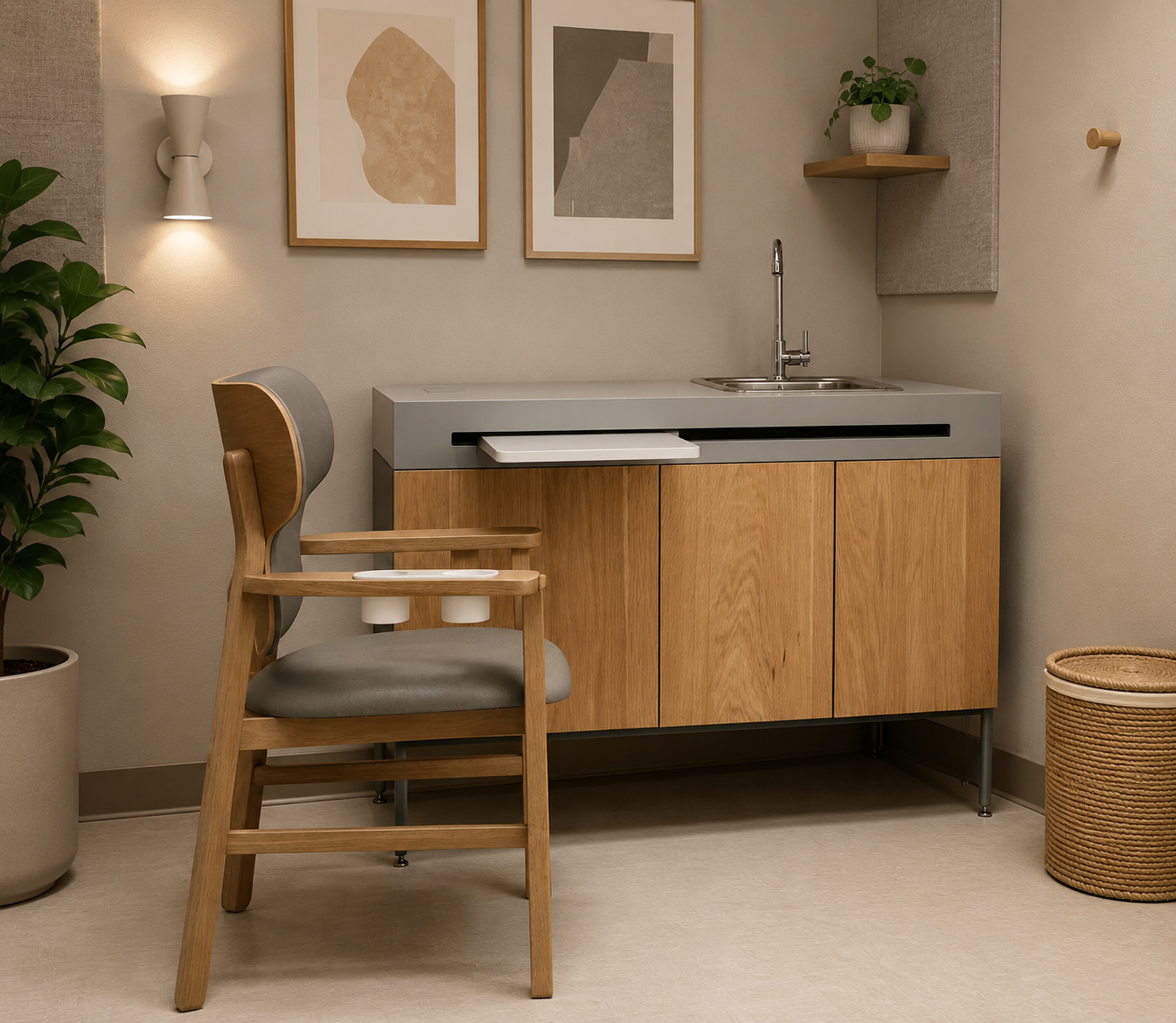
This is where the Nessel Lactation Station changes the math. It's a patented, all-in-one unit that transforms any small room, as compact as 5 by 7 feet, into a functional lactation space. No plumbers. No electricians. No waiting on a construction crew.
All it needs is a private room and a power outlet.
The station arrives fully assembled. Unbox it, plug it in, and it's ready. Inside, employees get:
- A sliding workstation designed for multitasking during a pumping session
- An optional plumbing-free portable sink, so cleaning equipment doesn't mean walking to a shared kitchen
- A temperature-controlled fridge for private, sanitary milk storage
- Built-in outlets for pumps and phones
- An ergonomic pumping chair designed solely for lactation rooms
A break room, a spare office, a conference room nobody's using this week. Any of these can become a compliant lactation space in the time it takes to unbox a delivery. That's the difference between minutes and months, and thousands of dollars.
No Room to Spare? There's Still a Solution
Some offices genuinely don't have an extra room to dedicate as a lactation room. That's a real constraint, not an excuse, and it's exactly what the Nessel Vessel pod line was designed to solve.
The pods come in two sizes:
- Petite, at 13 square feet, fits into tight footprints
- Standard, at 35 square feet, offers more room to move
All Nessel Vessel pods are certified compliant with UL STD 962 and ETL listed through Intertek.. Each pod includes a private locking door, skylights that bring in natural light, adjustable desk space, and outlets. They're also soundproofed, among the few pod options on the market built with that level of acoustic insulation, so what happens inside stays private in more ways than one.
You might notice these read less like office furniture and more like small, calm rooms someone actually wants to spend twenty minutes in. That's intentional. A lot of makeshift lactation spaces feel clinical or cramped. These don't.
These lactation pods install without a construction crew, too. While on-site assembly is required, installation services are offered through Nessel to make the process seamless ad and quick. Installation occurs in a matter of hours, not days and certainly not months. Companies with an open floor plan and zero spare square footage can still meet the requirement, and meet it well.
Sometimes It's Just a Chair
Not every situation calls for a full room overhaul. Sometimes a company already has a private space; it just isn't set up for pumping. That's where the Nessel Lactation Chair comes in. It's built with Greenguard-certified silicone upholstery that wipes clean in seconds, armrest bottle holders sized for major bottle brands, and ergonomic support for what can be a long, repetitive part of the day. It's a small addition with an outsized effect on comfort.
Buy, Rent, or Somewhere In Between
Budgets and timelines vary, so does the right ownership model. The lactation station is available to buy or rent.. The Nessel Jet Lactation Pod is also available to rent,
That flexibility matters more than it might seem at first glance. A company scaling up quickly, or testing a new office location, doesn't want to be locked into furniture decisions the way it's locked into a lease.
The Human Side of All This
Compliance gets a room. But someone still has to walk into it three times a day, tired, maybe anxious, trying to get back into a work rhythm while managing something deeply personal in a professional setting. A well-designed space says something to that employee, even if nobody says it out loud. It says the company planned. It says she wasn't an afterthought.
Employers who get this right tend to see it pay off. For every 1 dollar spent on corporate lactation programs, companies report making back 3 dollars in cost savings, largely tied to retention and reduced turnover among new parents. It's not just the compliant thing to do. It's good business, and it doesn't have to take months to prove it.
Frequently Asked Questions
How quickly can a company set up a compliant lactation room?
With a unit like the Nessel Lactation Station or a Nessel Vessel pod, a space can go from empty to fully functional in a matter of minutes or hours, not weeks or months.
Does a lactation room need its own plumbing?
Though the PUMP Act doesn’t specify this, it is recommended for sanitation reasons. The Nessel Lactation Station includes an optional plumbing-free portable sink, so a private sink is available without connecting to building plumbing.
Are lactation pods a substitute for a private room?
Yes. The Nessel Vessel pods and the Nessel Jet pods are self-contained, soundproofed, private units that meet the requirement on their own, which makes them a strong option for offices without a spare room to convert.
The Takeaway
An empty office doesn't have to sit empty for three months while a company figures out lactation compliance. Between the Nessel Lactation Station, the Nessel Vessel and Nessel Jet Lactation Pod lines, and the Lactation Chair, there's a path to a compliant, comfortable space that fits the room a company actually has, not the one it wishes it had.
If your organization is staring down a returning employee's start date and an empty room, Nessel can help you close that gap fast.
Sources
- U.S. Department of Labor, Wage and Hour Division, Fact Sheet #73: FLSA Protections for Employees to Pump Breast Milk at Work (revised December 2025): https://www.dol.gov/agencies/whd/fact-sheets/73-flsa-break-time-nursing-mothers
- U.S. Department of Labor, Fact Sheet #73A: Space Requirements for Employees to Pump Breast Milk at Work under the FLSA: https://www.dol.gov/agencies/whd/fact-sheets/73a-flsa-nursing-mothers-at-work-general-guidance
- U.S. Department of Labor, Pump at Work, Employer Responsibilities: https://www.dol.gov/agencies/whd/pump-at-work/employer-responsibilities
Disclaimer: This content is for general informational purposes only and does not constitute legal advice. Laws vary by state and change over time, so please consult a qualified employment attorney to confirm how these requirements apply to your workplace.

